Sunday, September 19, 2010

Varnish; length of boat projects

I've had Luckness now for around 15 months now, she arrived June 22nd 2009.

When I started working on her I noticed that the length of boat projects are mainly around twice as long as I would have expected.  I thought that over time my estimate accuracy would have improved, but that doesn't seem to be the case.  Here is another example of this...

Luckness' exterior is mostly fiberglass.  The caprails are teak, as are the hand rails, companionway hatch, and a few other pieces.  The varnish that was on the boat (actually Cetol, a varnish alternative) was worn out.  Once varnish starts to peel its too late for it, you need to start over.

Teak is an oily wood and the oil in it naturally protects it from the elements.  Many owners leave their teak to turn a natural grey, and it can last many years like this.  Over time, unprotected wood can wear down.  When I was looking at other boats before buying Luckness, I saw examples of boats the same age where the teak had been left unprotected and had worn to the point where it might have required replacing the wood to restore it.  Replacing he wood would be a horrific project, I do not ever want to do that.  As I would like to head down south eventually (Hi Boss!) where the sun is SuperBright I wanted the wood to be protected, and if protecting it now required some work that's what I would do.  "No shortcuts" is my motto.  I'm not afraid of a little work.  Do the project right.  No pain no gain.  Work now play later.

Here are a couple of the 'before pictures'.

After my summer vacation, which was spectacular, I came back to Seattle and there were blue skies and no rain.  Its like this every summer for a while.  I realized that if I was going to fix the varnish, that now would be the time to start.

There followed a short period of doing the research into different varnishes and the techniques.  I got some advice from Terry at Yachtfitters regarding the work, and off I went.  The varnish I choose was Epifanes Wood Finish Gloss.  This product does not need sanding between coats, which allows you to build thickness quickly.  I'm pretty happy with Epifanes, it was an easy product to work with.

My plan was to spend up to a month doing this, and then enjoy some more sailing.  I started this July 17.  Once I started, I took enough of the hardware off Luckness make working on her easier - but this meant she couldn't be sailed until reassembled.

The first step is to scrape the old varnish off the wood.  This involved using a heat gun to heat the old varnish and using a scraper to scrape it off.  I first scraped an eyebrow, the piece of wood below the handrail in the picture above.  Once that piece was done I sanded and started varnishing it.  I wanted to go through the entire process for one piece and learn before doing to rest.  Scraping the wood brought the teak back to its natural color, which looked good.  Sanding and varnishing the eyebrow looked amazing. I was getting hooked on this project.  I learned how thick to apply the varnish, now much time it needed between coats, what happens if you apply too late in the evening and you have dew that night (you lose all the gloss overnight) and how often to replace the tape I masked the wood with (no more than three coats.)  Having done that piece, I started on the rest of the boat.

There were two solid weeks of scraping - as I have a paying full time job, I can only do this weekday evenings and weekends.  The day job really interfered with this project!

When the scraping was done, I picked as many surfaces as I thought I could varnish in an evening and worked on those to completion - and then started on the next group.  When you throw in a few days of varnish fatigue, a few days of rain, its taken me most of the time between July 17th and now to work on it.  I had to disassemble the companionway to get the companionway cover out, as I didn't want any of the old varnish left.

Working on a group of surfaces was something like: tape (1 day); three coats of varnish (3 days); untape, retape (2 days); sand (1 day) two coats of varnish (2 days); untape, retape (2 days), sand (1 day), last coat of varnish (1 day), untape (1 day) - that's 14 days.  The boat was broken into three sections.  3 times 2 weeks plus 2 weeks scraping = 8 weeks.

Here is the boat during the project.


That picture was taken August 25th - still a lot of work to do.  Notice that the sun is shining and that it was taken in Seattle.  Also notice that the companionway in the picture above is temporary - the real one was in my basement along with the slats being refinished.

Its now Sept 19.  The exterior varnish is all done, except for the two pieces of wood which hold the companionway hatch in.  I'll do those over the next week or so.

The first picture below is of the caprail.  Compare it to the one above!   Can I have a few oooooh's and aaaaaah's?


I would like to say the project was totally worth it....but I want my summer back!  I thought this project would take a month or so, and now 8 weeks later I have a little bit of work left on it.  The wood looks really good now - but its started to rain here and I haven't sailed in 8 weeks.


I knew this was going to be a lot of work, and it was - much more than I expected.  Next year I can add a coat or two and that will be all that's needed.  That's part of the beauty of doing this work, once the varnish system is established properly, future maintenance is greatly reduced.  That's what I keep telling myself.  "The project was totally worth it!  I'm so ahead of the game now!"

I did take a few shortcuts - there isn't a mirror finish to the varnish, but its pretty acceptable.  Somewhere between utility and perfection.  It worked out well.  I didn't show the supply of bandaids I went though - it seems that when working with sharp tools for hours on end that its difficult not to cut some part of me.  All my digits are still intact.


I changed the oil in the engine today, along with the oil filter and transmission fluid.  There had been 120 engine hours since the last change, so it was about due.  I'd like to get the boat out sailing rather than working on it, just a couple things left to complete...


15 months of boat ownership.  It has been more work than I expected, and there has been less sailing than I had hoped for.  When I look at Luckness now and compare her to when she arrived, I'm really happy with the shape she's in.  The work I've been doing over the time I've owned her really shows - she's a solid boat and I smile everytime I see her.  My "no shortcuts" motto cuts into some of the fun, but I simply couldn't do it any other way.  I've progressed as a sailor over the 15 months, and yes, I'm including sailing skills such as being able to maintain your boat along with the other more traditional sailing skills - such as actually sailing.  I've learned things that I wouldn't have been able to learn through chartering boats.  Its been 15 months, some of it hard work - but I wouldn't change any of it.  I'm looking forward to the many more months to come.

Sunday, July 11, 2010

What I did on my summer vacation, 2010.

I left for a vacation on Luckness June 26th, returning July 11th - 16 days.  There was no real destination for the trip - I had a few goals, but they were related to gaining experience rather than any particular destination.

On Saturday June 26th, I met up with Jeff Moog and the gang for his Chowder Run aboard Angelique in Langley.  I arrived at 6pm to see Angelique already at anchor.  So I anchored a short distance off, put the dinghy in the water and motored over.  This was the first time I had Luckness anchored when I wasn't on her.  It was weird.  I kept poking my head up out of Angelique making sure she was still there.  I got more practice at being away from Luckness while she was at anchor during the holiday. Its still a bit of a strange feeling when I leave the boat empty, with no anchor watch ready to fix a dragging anchor while I go about what I'm doing on shore or elsewhere.  On Angelique the chowder and company were great, and I returned that evening to Luckness.

The next morning Angelique left south back for Seattle and I headed north toward the San Juans.  There were light winds all day and so I didn't make a lot of distance.  I chose to stay in Port Ludlow that night, not the first time I would be here for this holiday.

The next day I motored out into the sound and then sailed in light wind trying to round Point Wilson with the current against me.  After a lot of sailing back and forth, I rounded the point and entered the Straits toward Mud Bay on Lopez.
The wind eventually died, and I ended up motoring for four hours.  When I arrived at Mud Bay I found the bay perfectly calm, and took the time to calibrate my knot meter.  Its always read high, but I wasn't sure by how much.  After calibrating it, I now realize that the boat isn't able to motor at hull speed - 3300 rpm gives me 6.4 knots where the hull speed is around 7.1 - so I'll need to repitch the propeller, something to do when the boat is out of the water this winter having work done on her.

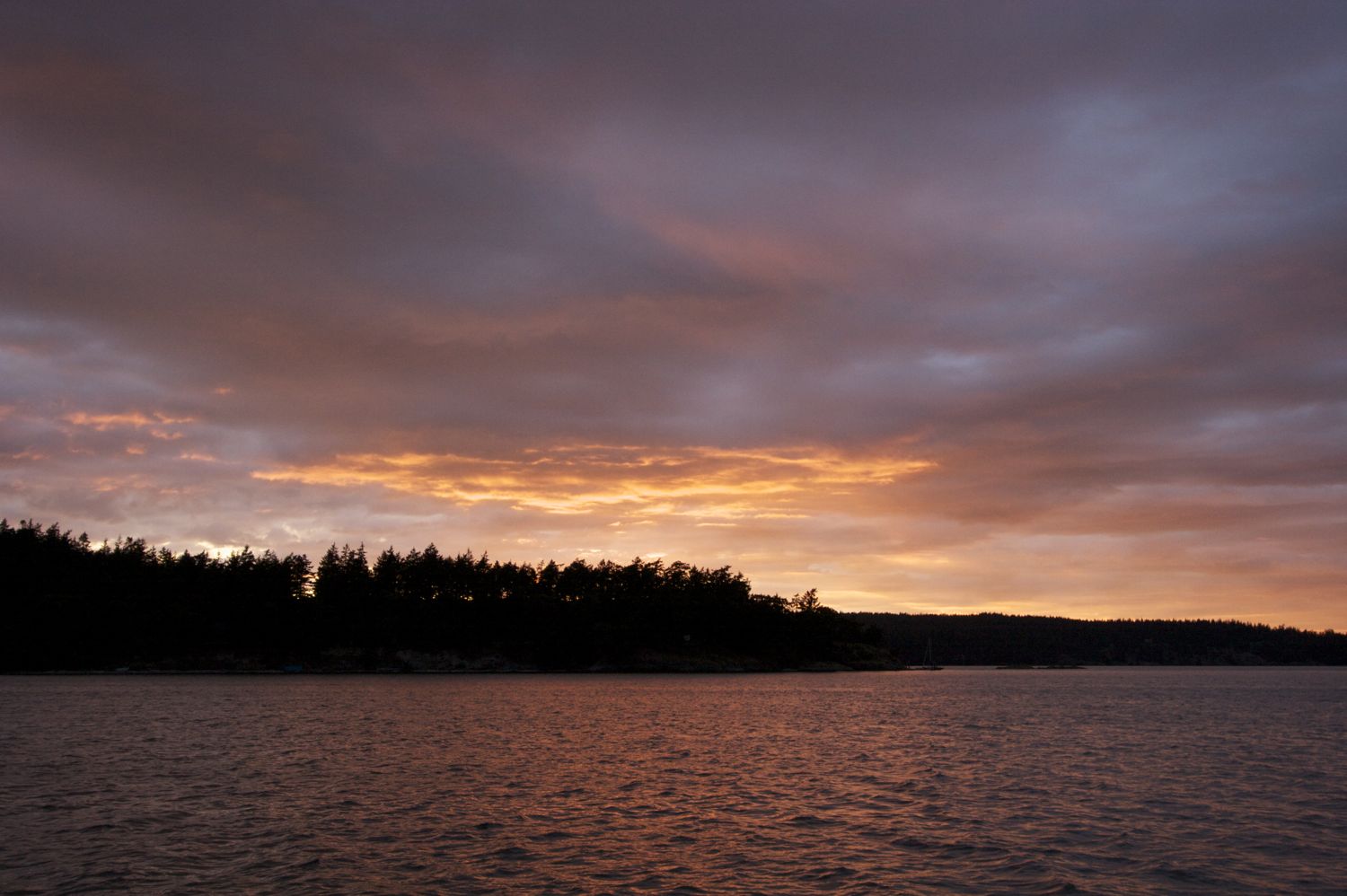
Mud bay was the first of many beautiful evenings. One of the things I really like about sailing is that it puts you closer to the environment.  I experience the weather and my surroundings more than when I'm in the city.  Here are a few pictures from that evening:
The next day I left Mud Bay and headed toward Echo Bay on Sucia.  Again, I had light winds, around 8kts SW for a lot of the day with an opposing current, so I struggled to make progress.  I cleared Cypress around 2pm and the wind improved to around 15 knots with gusts to 20.  During a slightly mismanaged jibe I saw 7.7 knots on the knot meter while I got things under control and pointed the boat back to where I was going (off of the beam reach she was on at max speed.)  As I got up toward Matia the wind started clocking around 360 at 0 to 2 knots.  After a while doing that, I got fed up and motored the rest of the way into Echo Bay.

The previous post mentions Echo Bay.  After staying here two days I realized that if I headed north toward the Gulf Islands there would likely be a long string of wonderful anchorages with nice islands to explore. At this point I changed my mind about what I was going to do.  I had been planning on heading into Canada, but instead decided to try to get out to Neah Bay for some experience.  The Gulf islands will have to wait until next year.

I first stopped in at Friday Harbor to buy a new charger for my cell phone.  While there I had a shower and ate on shore.  The shower was nice, by now I'd been out for 5 nights. But it wasn't really needed.  A sink bath works just fine and uses very little water.  The shower was a luxury, not a necessity.  There was no one else onboard, so this fact can't be disputed.

One of the biggest problems I ran into during the trip was my lack of electrical energy generation on Luckness.  My alternator is nothing special - its rated at 80Ah but it has an internal regulator and charges at 13.3 volts so it takes forever to charge the batteries with the engine.  I have no alternative energy yet, so the engine is the only way to recharge.  I was tempted to put into the marina in Friday Harbor - by now my batteries were at 12.2 volts, down 160 Ah - but the marina was pretty full and I wasn't able to get a slip with power.  I'll need a new alternator and voltage regulator, along with solar panels etc.  I knew about the need for solar panels but didn't realize how lame my alternator was.

I anchored in 60', fuel at 31 gals having consumed around 7 gallons so far.

I left Friday Harbor July 2nd heading toward Port Angeles.  I intended to stay at Port Angeles over night and head out to Neah Bay the next day.  The winds were light so I motored out through Cattle Pass and past Salmon Point where I started to sail in light wind.  By 5:30 there were 15nm to go so I had to reevalute.  I changed my mind and decided to stay at Dungeness Bay overnight - there is not much protection there but with light winds it was viable.  Within 30min or so the winds had picked up to 15 to 25 from the west.  I arrived at my intended anchorage and quickly decided that I wasn't going to stay there and reevaluated again.  Port Angeles would have been a long bash, and I didn't want to enter an unfamiliar anchorage in the dark with this wind.  So I decided to head east toward Port Townsend.  I got the sails back up and headed downwind.  This was a fun ride.  I was seeing boat speeds around 7 knots, sometimes faster sometimes slower.  The apparent wind was showing 18 to 22.  The boat felt wonderful, very reassuring.  As I was rounding Point Wilson it was around 10pm, the stars were out, the sky was clear, and my wake was glowing!  Luckness' keel is 5' 6" deep, and behind the boat was a column of bioluminescence about 2 feet across and 6 feet deep glowing brightly.  When I moved forward to the shrouds and looked over the side, the wake was sparkling with light, it was wonderful.  At this point I reevaluated my plan once again.  I was having fun and decided to keep sailing toward Port Ludlow.  I arrived at anchor at 2am.

The next day I was pretty tired, having been at the helm for 17 hours the previous day, so I slept in and took a day off, working on boat projects and reading.  On July 4th there was a gale warning around Neah Bay and the middle of the Straits, so I decided to stay one more night. This put me in Port Ludlow for July 4th.  I expected a few small fireworks along the shore but nothing large.  I was mistaken.  There were four or five houses along the shore which seemed to compete for the largest display.  One of the houses had around a 45 min intense display of high level fireworks - it was amazing.

By July 5th I had decided to give up on my Neah Bay plan and simply head back to the San Juans and explore some more.  By now the batteries were at 12.0v which meant more motoring was in store.  I bought 10 gallons of fuel at the marina.  I motored most of the way past Point Wilson in wind I could have been sailing in.  I hated this - there were other boats out sailing and here I was motoring.  I normally feel good about sailing while other boats are motoring.  After a few hours I entered the Straits and I started to sail.  I was on a beautiful close reach most of the way to Lopez.  The wind died just as I rounded the southern corner of the island and I motored the remaining distance back to Mud Bay.  I gained 108Ah, batteries back to 12.7v.

The next day I headed to Blind Bay, where I did some more dinghy exploring.


From Blind Bay I went to Reid Harbor where I took the dinghy ashore again.  From Reid Harbor I went to Roche, from Roche I went to Mackay Harbor, from Mackay I went to Port Ludlow, and the next day, the 11th I headed back to Shilshole.

It was a good trip.  I wasn't sure if single handing the boat for 16 days would wear me out or what I would find out about the experience.  Single handing was just fine, I enjoyed it.  Luckness was wonderful, with a few system improvements related to energy she would be an awesome coastal cruiser.  For blue water cruising I want to add a few more things, but that will come.  

The hardest thing I encountered single handed was leaving anchorage one day in about 15 knots of wind, the wind blew the boat around as I was trying to raise the anchor and wash the mud off the chain - this was a little tedious involving much walking back and forth, bow to the helm.  I'll need to work on this.  Having identified this as the hardest thing - I realize the weather and winds weren't challenging.  The hardest thing would be bound to change given different conditions!

I didn't get a chance to sail throughout the night, but this will be better left to after I have a self steering unit installed.

I used around 30 gallons of water during the trip, of 80 I had onboard.  I didn't use the pressure water at all.  The foot pumps for fresh and salt water in the galley and head were preferable and probably lead to less water used.  I didn't use the water from the hot water tank at all - when I wanted hot water I heated some up on the kettle.  I'm considering if I even need the hot water tank - the space it occupies would be valuable for something else.

I used my pressure cooker for the first time on this trip.  You can make beans in 28min!  Beans and rice is a viable (supplement to the) food plan.  For this trip I didn't plan meals too closely, I just brought a bunch of ingredients and made it up as I went.  The only thing I almost ran out of was granola.  I'll need to learn how to make my own.  I ate well on the trip - and by well I mean it was healthy simple food.

There was too much garbage generated, I'll need to reduce packaging next time.  I also had too much plastic onboard, I'd like to try to minimize this in the future as well.  On offshore passages you can't toss the plastic overboard, but you can toss most other garbage.  Avoiding plastic would be a good habit to get into.

One last thing I noticed during the trip - I felt good.  My dreams were vivid and cool.  I felt creative and challenged.  There was a lot of smiling going on.

I feel lucky to have this boat and to be able to do all of this.  I'm looking forward to more of it in the future.

Tuesday, June 22, 2010

New Dinghy!

For anything except moving between marinas, a dinghy is pretty much an essential item for a cruising boat.  In the past, I've sailed around Puget Sound without one, and have spent many fine nights at anchor in wonderful anchorages.  However I couldn't get to shore.  Or set crab pots.  Or visit my neighbors.  Or head into town without docking the boat at a marina.  Buying a dinghy has long been on my list of things-to-do.

Doing research on which dinghy to buy lead to a lot of confusion.  The choice of motor also was also not a clear cut decision.  I wanted a dinghy made of hypalon, so that it would survive strong sun.  Beyond that, there are arguments for buying the biggest dinghy you can fit on the boat, or buying a RIB which has a rigid fiberglass floor but that doesn't roll up, or buying a wood floor, or not buying a motor but rather buying a dinghy you can row more easily, or buying a large motor that will speed the dinghy along, or buying a small motor which is light and fuel efficient.

In the end, I bought an Achilles LSI-260.  It has a high pressure inflatable floor, which means I can deflate the thing and roll it up into the size of a duffle bag.  This will be useful for offshore passages where I can store it below in the cabin.  Its 8' 6" and weights 66 lbs.  The motor is a Tohatsu 3.5 hp 4 stroke.  It weights 41 lbs.

I bought it at Ballard Inflatable Boats, in Ballard.  I always prefer to spend my money locally, and they gave me good service and advice.  They are recommended.  They will also talk you through the technique for affixing the registration letters/numbers onto the dinghy, which was useful.

Here's the dinghy in Echo Bay on Sucia Island.  I've been in this bay three times, but this is the first time I've been to shore.  The Island is wonderful, there is a lot of good walking, lots of camping sites, fire pits.  Being able to get to shore totally changed the visit this time.

The dinghy is also a perfect fit for Luckness.  The dinghy fits perfectly in front of the mast and behind the staysail stay.

Getting the dinghy up on deck is easily done using one of the spare halyards, the spinnaker halyard works well.  Attach the halyard, winch it up using one of the winches at the mast, flip it over and tie it down.  The side decks are free so I can still walk up and down both sides of the boat stern to bow.

After my visit to shore in Echo Bay I was returning to the boat in perfectly calm water.  I went out toward the mouth of the bay where there were no boats around and wanted to see how fast I could get the dinghy going.  I found that in perfectly calm water, with one person aboard, if I opened the engine up to wide-open-throttle, then shifted my weight forward as much as possible I could just get the dinghy up out of the hole it was in and onto plane.  Once the dinghy was planing it hit 10.7 knots!  That yielded big wide grins!  If there are any ripples or waves on the water at all, it won't plane.  But it gets around pretty well, going 5 to 6 knots.  Its a rockin little tender.

Tuesday, June 1, 2010

Memorial sailing

Saturday I left for Quartermaster harbor. It was a grey morning and I didn't get away from the dock until 11:30. There was a decent wind - S10 and so I started sailing upwind. It was pretty slow progress and as I made my way past Alki point at 3pm I was wondering when I would need to turn the engine on and motor to the harbor. I kept on trying and at around 5 the wind improved toward the south end of Vashon Island and I started making better progress. By 8:30 I was approx 5 miles from the anchorage and I brought in my genoa and started motoring. I set the anchor at 9:30, just as it was starting to really get dark. The moon was almost full on Saturday - but it didn't rise until later that night.  The clouds had been clearing for the previous few hours and I made dinner and ate beneath the stars in an anchorage where my anchor light was the only one visible.

Sunday's VHF weather report was not encouraging. The stations they list describing the current conditions progress from north to south in the Sound. Seattle was 5 knots, Alki Point was 0.8 and Point Robertson reported 'winds calm.' This didn't change and I decided to stay at Quartermaster rather than motoring to some other anchorage. So I read for a while, worked on a few projects, read some more, worked on the boat some more. It would rain off and on all day.  It was a pretty productive and relaxing day.

Monday morning I woke at 6am to dead calm in the anchorage, so I went back to sleep. Woke at 8, no wind, slept again. Finally got up at 9:30 and left by 10:30. The wind reports for the south sound were light - 6 knots at Point Robertson when I left but there was stronger winds up north - 13 knots at West Point where I was going. As I left the anchorage and turned a corner toward the sound the winds strengthened and I was able to leave the harbor under sail. That lasted for about an hour at which point it died and I motored up Calvos passage on the west side of Vashon for an hour or so. Suddenly - the wind started to arrive. Within the span of a few minutes I had what seemed like 10 - 15 knots of south wind. I brought out the Genoa, shut down the motor and was able to sail the rest of the way back to Shilshole. The grey and cold of the morning was replaced with blue skies and warmth.

Another beautiful weekend of sailing. I'm looking forward to picking up the dinghy this week - for one thing it will make taking pictures of Luckness much easier.